

It’s hard to believe that the Slovenian superstar couldn’t excel on any course. But could the 2026 route itself give him an edge over his competitors? Let’s take a look.
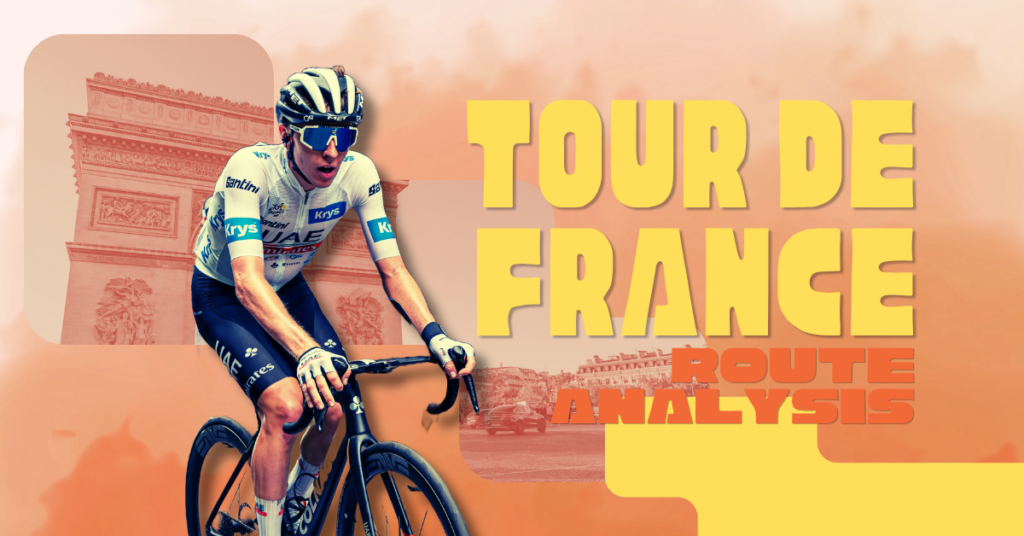
As we approach the 2026 Tour de France, starting a little less than a month away on July 4th, we’re starting to think more closely about the logistics — the stages, the finales, the best climbs, and the decisive days. Some fans, including those in this Reddit thread, are coming to an interesting conclusion: that this year’s parcours might just give the edge to the already-all-out-favorite, Tadej Pogačar.
Is a favorable route really needed to continue his dominance in the sport right now? Maybe not. But a sequence of stages that suit him might prove a steep uphill battle for his top rival, Jonas Vingegaard. A close look at the stage-by-stage reveals that the race might be a good suit (whether intentionally or inadvertantly) for Pogi’s talents and strengths.
A team effort in Barcelona.
The Tour de France is always influenced by its Grand Depart. However, even looking beyond that, the opening two weeks will offer Vingegaard very little room to gain meaningful time. The race begins with a team time trial, where Pogi’s Team UAE Emirates and Vingegaard’s Visma Lease-a-Bike are expected to be closely matched. This makes a significant gap unlikely.
Is that really true, especially for a TTT? Some might argue that Visma has a genuine edge given their roster of elite time trialists. Vingegaard, Wout Van Aert, Edo Affini, Bruno Armirail, and Victor Campenaerts all look stronger than UAE’s lineup on paper, which ends up feeling a bit thin… particularly without João Almeida or Juan Ayuso.
But keep in mind, if UAE’s intended support for Pogi is structured around the climbers, like Isaac del Toro, (along with the reality that Pogačar can go it solo if needed) then a starting TTT might be a non-issue in the end. Any deficit that Visma gains early on might dissipate with each uphill finish, if it happens that Vingegaard isn’t on form.
As always, it seems that the Pogačar versus Vingegaard rivalry leans a bit more heavily on the individual strength of the two, rather than team support as the deciding factor.
Embed from Getty ImagesTrouble in a puncheur’s paradise?
What about the other early stages?
Many feature shorter, punchier climbs near the finish… and these are precisely the kind of terrain where Pogačar excels as both a climber and an attacker. We might be He may not build a dramatic lead, but the expectation is that he arrives at the mountains having already edged out Vingegaard by a small but meaningful margin.
Like we saw in 2022, during Pogi’s brief stint in yellow, that shifts the burden of initiative onto the Dane for the rest of the race.

Read More:
Are We STILL Witnessing the Greatest Cyclist Ever? What Tadej Pogačar Means For Cycling in 2026
The hardest stages are where decisions will be made.
Once we get into the high mountains, it will be time to shake out whether Vingegaard can really be stronger than Pogačar. Again, it seems the odds are stacked against him… even if only slightly.
The first true mountain stage on Stage 6 features the iconic Col du Tourmalet, but the actual finish line will be nearly 40 kilometers beyond it. This stage is ending up on a relatively gentle climb that averages just a 3.7% gradient. There was a similar 2024 stage where Pogačar gained time on Vingegaard after Vingegaard attacked on the Tourmalet, so it seems this type of parcours rewards Pogi’s explosive style. Vingegaard will need to be highly strategic to gain time here.
Stage 15 might be Vingegaard’s first genuine opportunity. It finishes atop a tough hors catégorie, or uncategorizable, climb. This is truly the stage where Visma would need to ride the hardest and most aggressively from the start. Then (and only then) they might have a shot at draining Pogačar’s reserves before the final climb.
Without a sustained effort, what happens? A tough climb alone is unlikely to crack him. The individual time trial that follows on Stage 16 also has enough climbing to be somewhat interesting, but unlike in 2023, it’s not the kind of stage where Vingegaard’s time trial skills can open a decisive gap over Pogačar.
The second major opportunity for VLAB arrives on the Alpe d’Huez stage. But this year, the stage is unusually short, just under 130 kilometers. For Vingegaard to isolate and crack Pogačar on this compressed course would be pretty remarkable because none of the riders are going to be fatigued; even some of the puncheurs like Wout Van Aert could have a shot here.
The final mountain stage, which has three hors catégorie climbs, has potential, but again, it concludes with around 14 kilometers of relatively flat road. Any single climbing attack can inflict minimal damage here.
Embed from Getty ImagesCan Vingegaard repeat his past strategies?
If we look back to 2022 and 2023, we see what this route really lacks.
A brutal, multi-day mountain situation is best for exposing Pogačar’s weaknesses on a bad day. But in 2026, there’s no equivalent of the 2022 Alpe d’Huez stage or the 2023 Col de la Loze finish that once broke him down. Instead, Vingegaard’s most realistic strategy is to limit his losses…. which doesn’t sound good.
If he can stay within striking distance across the first two weeks, and go hard on climbing stages, he can hoping Pogačar trips up. But then again, on this terrain? He still very rarely does.
We don’t know that Pogačar still has any real vulnerability on long climbs like he once did. It’s easy to point to 2022 and 2023 and say that it could happen again, or to say that Pogi has trained those weaknesses out of his system and is no longer vulnerable. The most nuanced take might be that he he remains beatable on long climbs, but only if he’s forced to set the pace himself. If he can sit on wheels, he won’t really get dropped by anyone.

The 2026 route creates a tactical advantage for Pogi… but not a tactical impossibility for Vingegaard.
So what will really happen?
It’s likely that Vingegaard and his teammates will be riding hard to drain Pogačar. At the same time, this also drains Vingegaard. Without a strong GC satellite to create a multi-front threat like they’ve done in the past, their options are still pretty limited.
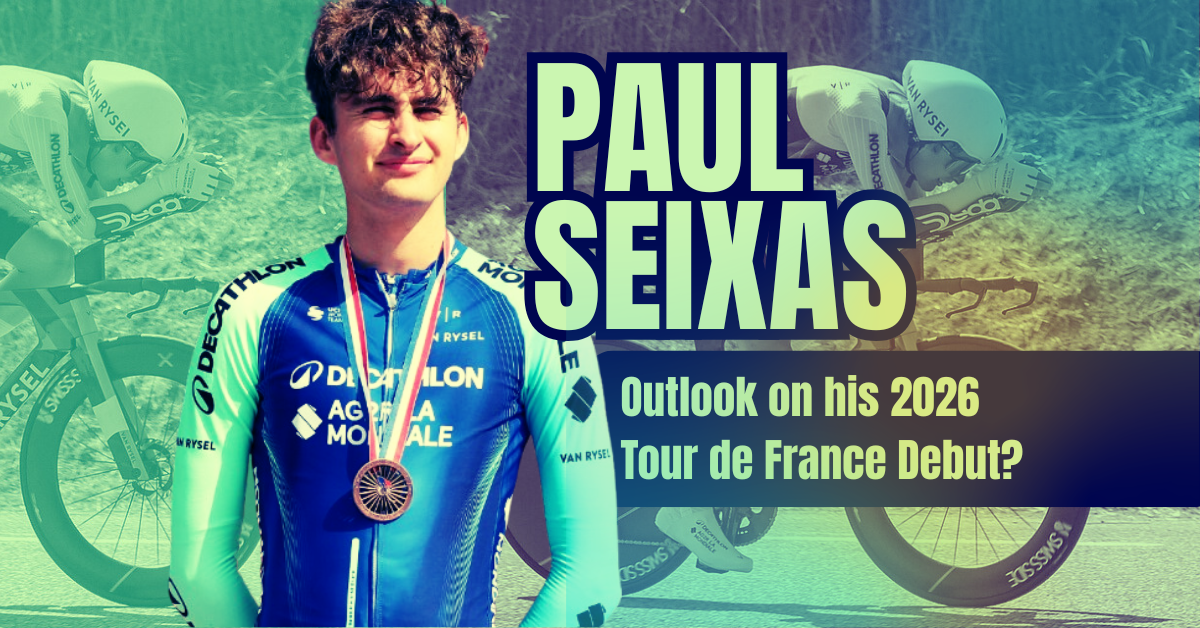
The parcours is best for Pogi, but will it really be a two-man fight this year? Another saving grace from Vingegaard’s perspective is that a breakout performance from a third contender, like Paul Seixas, Remco Evenepoel, or Florian Lipowitz, could complicate the race. With two riders attacking in unpredictable ways, it might be enough to prevent it from becoming the type of mano-a-mano slugfest we’ve seen (and occasionally enjoyed) in years’ past.
Embed from Getty ImagesLikely, the Tour de France wasn’t designed to favor one competitor over the others. It’s simply getting harder to design a Grand Tour route that doesn’t favor Tadej Pogačar. That’s because his weaknesses are changing; not that he doesn’t have weaknesses at all, but that his competitors aren’t always doing what they need to do to break him.
When the Tour de France parcours is playing by the rules, maybe it’s time for Pogi’s rivals to think outside of them. Then we might have a real fight on our hands this year!

What do you think about the Tour de France route? Does it favor Pogačar, or will Vingegaard and the others still have a fighting chance? Let us know what you think below, in the comments or on social media! ★
Visit our Tour de France hub!
Get ready for the Grand Depart in Barcelona and beyond.







Leave a Reply