

Milano-Sanremo is the longest race on the professional men’s cycling calendar. But did you know it’s also one of the most beautiful and beloved by cycling fans?
Let’s explore why this Italian classic occupies such a unique spot in the cycling world, and why it’s worth watching year after year.
The most patient monument.
Our adventure from Milan to San Remo begins at the perfect time of year. In the early cycling months of March and April, excitement for the rest of the races to come is at its highest.
Fans are eagerly tuning in to Strade Bianche, the race of the white roads (although the last few seasons have left us without much suspense…) as well as other Flemish classics. They’re seeing their favorite riders for the first time since off-season, and looking forward… even to the Giro d’Italia, our first Grand Tour on the year’s horizon.
The weather at each year’s edition of Milano-Sanremo reflects the change to spring. Of all the early-season Italian classics, this is one of the mildest; it draws a sharp contrast to earlier, colder races, and later contests like Paris-Roubaix (not called “the Hell of the North” for nothing!) Even Tirreno-Adriatico and Paris-Nice don’t hold a candle to the pleasant, spring-like vibes we see on the descent into San Remo itself.

A long day on the bike ends in the most beautiful finale in cycling.
Of course, what is most famous about Milano-Sanremo? The descent on the Poggio, coming into San Remo itself.
But why race over 300 kilometers for 10 minutes of action at the end?
In this way, the finale also requires patience and resilience. Milano-Sanremo is easy to finish — just stay on your bike. It’s difficult to win, because it’s unpredictable. Anyone can win at MSR, if they play their cards right! And, being a Monument, winning is also a huge honor.
Keep in mind: despite the unpredictability, there’s not a lot of racing carnage at Milano-Sanremo. It’s more elegant and thoughtful than that. In many ways, it’s also a race for a patient audience and an audience that really loves cycling for cycling’s sake.
Sold? Not yet? Let’s talk about the geography, and MSR’s journey from Milan to the gorgeous scenes of the Mediterranean sea.
Embed from Getty ImagesExploring Italy with a parcours rooted in tradition.
Starting out watching Milano-Sanremo, you might not guess that it has beautiful landscapes along the way.
The beginning section in Milan (note that in 2026, the race will start from nearby Pavia and then go into Milan) is on the drab side. The first 150kms tend to be flat and can sometimes be wet or misty as well. Unlike other races where fog and gray weather give us a little intrigue and mystery, this can feel more… boring. Especially with so much distance left to go!
But the riders aren’t slacking, and this section of the race can actually pass quickly due to their speed. Monotonous, but building our interest for what’s to come.
The peloton reaches a turning point at the Passo del Turchino, which takes us from a plains-style terrain into more coastal vibes. At the summit of the pass, the riders go through a tunnel and emerge onto a descent towards Genova-Voltri.
From here, sights of the coastline are common. Parts of the route are carved into the cliffs of the Mediterranean coast, a section of roadway called “Via Aurelia.” The technicality of this section is also pretty compelling and the peloton will stretch out.
But this isn’t just a chill beach day, because towards this section are where the famous climbs appear.
Embed from Getty ImagesThe climbs of Milano-Sanremo, including the “capi,” Cipressa, and Poggio, are iconic in cycling lore.
Have you heard of the “capi” before?
These three climbs (Capo Mele, Capo Cervo, and Capo Berta) on the Via Aurelia precede the decisive sections of the race. None of these climbs are particularly challenging or critical to the race; Capo Berta has seen some attacks over the years.
But these sights are gorgeous.
After that, the Cipressa climb is increasingly becoming an important tactical site in the race. It measures 5.6 km, at an average gradient of 4.1% — not extrordinarily steep. In the modern era of cycling, this climb is where we see weaker riders in the peloton start to struggle. And that can lead to a clear separation between who is competitive for the race win, and who is falling behind.
Finally, we’ve come to the absolute best part of the race… and the most famous. There is a brief respite before the Poggio, and after that is where the race is most often decided.
Embed from Getty ImagesA descent into San Remo.
Believe it or not, the Poggio di Sanremo hasn’t always been part of this race.
It was first introduced in the 1961 edition of the race. But these days, it’s emblematic of MSR and everything we look forward to as viewers each year.
At 9 km to go, the peloton hits the foot of the Poggio for a 3.7 km climb at around 4%. The steepest ramps in this section peak at 8% near the summit — the decisive point of the climb. Here, the road narrows slightly, and the first two kilometers of descent feature four hairpin bends.
Make no mistake: this descent is fast and demandingly technical. The very final section of the descent is where we come into the outskirts of Sanremo, where the race finishes.
There’s nothing I can write that will convince you that it’s worth watching 290km of next to nothing for these last ten minutes of racing.
It’s something you’ll just have to see for yourself…
Is Milano-Sanremo really as unpredictable as we think?
Historically, MSR could be contested by either sprinters, puncheurs, or even climbers. This always led to an unexpected result, whether it would finish with a bunch sprint or be decided on the final climbs or descent.
However, recent years have moved away from a sprint finale. Maybe because teams are better than ever at conserving their GC-type rider until the end; or because super-teams of top domestiques now push the pace too hard for most sprinters to keep up.
But there’s still plenty of suspense and excitement. Just think of some of the most memorable MSRs of recent years:
- A photo-finish sprint battle between Jasper Philipsen, Michael Matthews, and Tadej Pogačar in 2024.
- A crazy snow-day in 2013, with many riders abandoning due to the freezing conditions
- Sean Kelly attacking on the descent to chase down a rogue solo breakaway in 1992
- Matej Mohorič’s devilish descent to victory in 2022
And this is only a sampling of some of the best editions of this race!
Embed from Getty ImagesA challenge, a chase, and a chance for risk-takers.
Maybe MSR remains so timelessly interesting because riders are always willing to push limits.
Matej Mohorič supposedly joked at the start line in 2022 about whether San Remo had a good hospital, in case he crashed.
Is a chance at winning MSR worth a trip in the ambulance? Probably not! But it just goes to show how special this race is, that riders are especially daring and willing to take risks for a chance at victory.
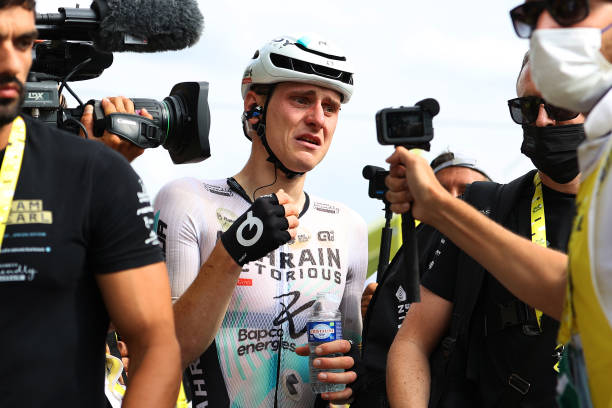
Celebrate the arrival of spring and let’s journey from Milan to San Remo together!
I’d ask you again: is there anything that can convince you that it’s worth watching 290km of nothing happening for just 10 minutes of glorious racing?
Once you believe it, you’ll have to watch every single year.
As the race nears the finish line, you might see some palm trees on the coastline or what is called in Italian “the Coast of Flowers,” Riviera dei Fiori. What could be a more beautiful way to welcome spring racing fully than by this year’s edition of MSR?
Are you ready? Grab your bottle of prosecco, settle in for a good seven or so hours… and let’s wait together to see the best Monument racing springtime in Italy has to offer!
What’s your favorite thing about MSR? Let us know in the comments or on social media! ★








Leave a Reply