

When Tadej Pogačar crosses the finish line, there might be only one rider in the world capable of staying with him. And that rider is Mathieu van der Poel.
But is this rivalry worth your attention in 2026 and beyond? Absolutely. Here’s why these two athletes represent something unprecedented in the sport: a rivalry that transcends race type. Let’s take a look at the past, present, and future of this unexpected duo.
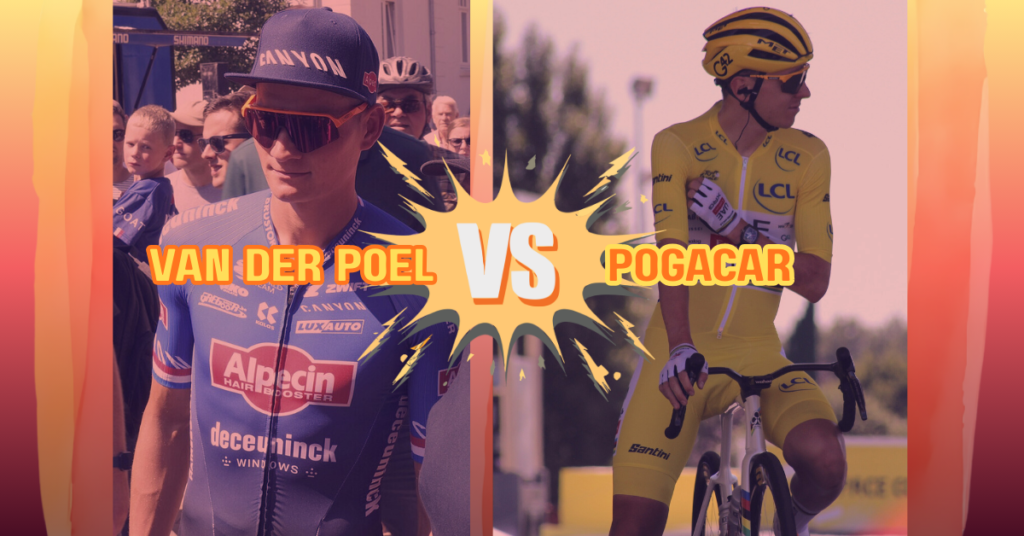
The foundation of a Pogačar vs van der Poel rivalry.
How do most cycling rivalries come about?
In the past, from repeated head-to-head battles in a single discipline. You might consider Chris Froome vs Alberto Contador in Froome’s early Grand Tours, or Pogačar vs Jonas Vingegaard at the Tour de France.
The new Pogačar vs van der Poel rivalry breaks this mold entirely.
Tadej Pogačar is 26 years old and racing for UAE Team Emirates, a team built around his success. He’s won four Tour de France titles (2020, 2021, 2024, 2025) along with the 2024 Giro d’Italia. His palmares (for the un-initiated, the French term for a rider’s complete record of victories) includes monuments like the Tour of Flanders and Liège-Bastogne-Liège. He naturally excels in stage races requiring sustained performance over three weeks, but under the surface? He’s also increasingly explosive with his one-day racing capabilities.
What about Mathieu van der Poel? He is 30 years old and approaches cycling a bit different. His team, Alpecin Premier Tech, is also built around him. He’s a world champion in cyclocross , showing that he’s not afraid of mud, difficult terrain, or short explosive efforts. Van der Poel has also conquered some of cycling’s most prestigious one-day races: the Tour of Flanders, Paris-Roubaix, and Milano-Sanremo. He was the road race world champion in 2023; Pogačar held the same title in 2024 and 2025.
The key difference between the two: unlike Pogačar, van der Poel rarely targets three-week Grand Tours. He focuses all his racing energy on explosive, high-intensity events like one-day races.
So how can it be that these two riders could become great rivals?
Embed from Getty ImagesWhat makes the Pogačar vs van der Poel rivalry different?
The competitive tension between these riders isn’t diffused one bit from their contrasting racing philosophies.
On the surface, Pogačar represents cycling’s traditional progression as a GC rider: the sport’s highest prestige. Van der Poel embodies the explosive specialist, a rider who can produce devastating accelerations that crack opponents in minutes rather than weeks.
But when they race together, these dynamics shift dramatically. In the 2024 Tour of Flanders, van der Poel attacked with 28 kms remaining on the Oude Kwaremont climb. This is a steep cobbled ascent that defines Flemish racing, and is usually conquered by only the most explosive riders. Only Pogačar could follow, and their subsequent collaboration distanced the entire field before van der Poel won the final sprint.
It didn’t matter that this type of attack was closer to van der Poel’s specialty. Pogačar’s strength as an all-rounder brings him up to the same level. And the data supports their unique match-up: according to ProCyclingStats, Pogačar has won 20 Classics races over the course of his career, compared to van der Poel’s 21. Their even-footing in this discipline separates both of them from GC contemporaries like Jonas Vingegaard or Remco Evenepoel, who focus primarily on stage racing.
Embed from Getty ImagesWhere will the rivalry take us in 2026?
Does 2026 present particular intrigue for Pogačar vs van der Poel? Several factors may converge this year to help elevate the significance of their rivalry across the season.
The two will have several direct confrontations over the course of the year. Van der Poel will likely race the 2026 Tour de France, potentially setting up wins on punchier mountain stages where Pogačar typically dominates. Meanwhile, Pogačar continues expanding his classics campaign, targeting races like Paris-Roubaix where van der Poel excels on cobblestones. The rough, stone-paved roads that require exceptional bike handling; this is something both Pogi and van der Poel have in abundance.

Read More:
Discover the top riders to watch in 2026.
As each of these riders continue to encroach on the others’ disciplinary territory, they’re also still both in their peak physical years. Pogačar has demonstrated more tactical maturity in recent seasons. Van der Poel, at 30, is still maintaining the raw power that characterizes his attacks. Neither of these riders are exiting the optimal periods for their performance, which bodes well for a long-lasting rivalry.
Finally, consider their team investments. UAE Team Emirates is the most powerful superteam in the sport, with a roster capable of controlling every Grand Tour while also supporting Pogačar’s classics attempts. Alpecin, on the other hand, recruits support specifically for van der Poel. The organizational commitments on both sides will do their part to ensure both athletes receive maximum support… and creating the most exciting rivalry possible for us to watch!
Embed from Getty ImagesDefining their head-to-head moments.
What really happens when Pogačar and van der Poel race together?
There are some certain patterns that have emerged over time. For example, van der Poel typically initiates attacks. He is known for his sudden accelerations that create separation from his rivals. But Pogačar is no slouch, and he can also launch his own attacks, or respond with sustained power. He often matches van der Poel’s surges or can outpace him when timed correctly.
Their 2024 world championship road race was a great illustration of this dynamic. Van der Poel attacked repeatedly on the circuit’s climbs, but Pogačar covered each move. He also looked more comfortable than van der Poel on sustained climbs. Eventually, Pogi took his usual tactic and soloed to victory.
Yet, it was van der Poel’s aggressive attitude that forced Pogačar to produce his exceptional performance. He couldn’t simply rely on superior climbing.
Is van der Poel the solution to the “witnessing greatness” conundrum? Maybe not. But mutual pressure is able to elevate both riders.
Neither Pogi nor van der Poel can race conservatively when the other competes, even if they can easily outpace the peloton on a given day. Their tactical battle creates some of the innovation and risk-taking that spectators can enjoy!
Should new fans care?
If you’re unfamiliar with professional cycling, you might wonder: why does this matter?
The Pogačar-van der Poel rivalry doesn’t always happen, because they don’t always race the same races. But they represent cycling’s evolving identity in a way that’s worth noticing.
Historically, the sport segregated specialists: climbers won mountains, sprinters won flat stages, classics specialists won their one-day races. But these two athletes, Pogačar and van der Poel, blur those categories. Their talent transcends those limitations, and they are even more dynamic when pitted against each other.
Contrasting styles also provide accessible entry points for new fans.
Do you prefer the explosive, aggressive racing? Both Pogačar and van der Poel deliver some spectacular attacks. Or do you enjoy the sustained strategic battles? Just wait until they face each other… No matter which rider you prefer to win in the end, both offer compelling race narratives.
But don’t think that it’s Drive to Survive-style manufactured drama, either. Their post-race interviews consistently feature each rider praising the other’s capabilities. They have a lot of sportsmanship, which combined with competition, creates a great sporting narrative to enjoy.
The verdict on Pogačar vs van der Poel.
Is this rivalry worth following this year and beyond? We’d give it an emphatic: yes!
Both riders are at their peak form and have massive organizational support. There has never been a more interesting time to get engaged. And their head-to-head is brought into even sharper relief by the broader competitive landscape, which lacks comparable matchups at this talent level.
Sure, Jonas Vingegaard and even Remco Evenepoel provide some Grand Tour intrigue for Pogi. But does either possess van der Poel’s explosiveness? For van der Poel, Wout van Aert offers some versatility on his good days, but his recent form doesn’t hold a candle to Pogačar’s consistency.
Embed from Getty ImagesMore fundamentally, this rivalry asks us as fans some compelling questions about cycling’s future.
Is the solution to stage race dominance matched explosivity… or is that just leading to full-calendar dominance? Will van der Poel’s focus prove more sustainable than Pogačar’s jam-packed racing schedule? How do contrasting strategies affect these individual outcomes?
All very interesting questions that we don’t have answers to just yet.
But the answers will emerge through 2026’s racing season. These two, going head-to-head, will provide a narrative thread that makes cycling more dynamic and enjoyable.
Are you ready for some actual excitement? In the “witnessing greatness” era, van der Poel is still out there waiting… and he may be our only promise for a close contest this year.
Embed from Getty ImagesDo you like seeing Pogačar race in the classics? Do you think van der Poel is a match for him? Let us know in the comments or on social media! ★




Leave a Reply