

From Chris Froome to Tadej Pogačar, why have so many pros called this region home? And are the reasons behind the choice really worth it?
It turns out that Monaco has real appeal for a pro cyclist, but it’s complicated. The tax benefits are huge… but so are a few of the trade-offs.
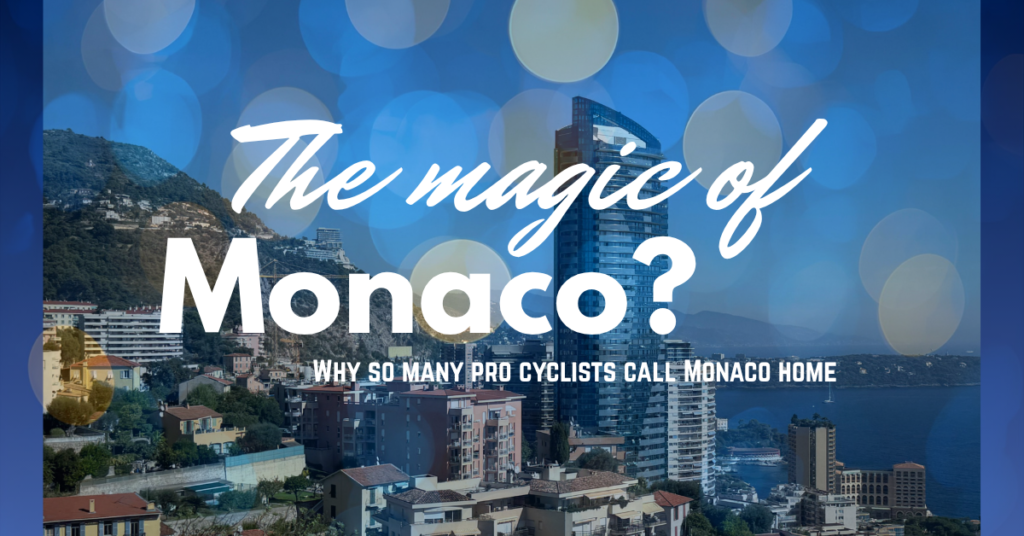
The tiny principality of Monaco has only 2 square kilometers, 40,000 residents… and a surprisingly high concentration of pro cyclists.
According to a Monaco tourism site, over fifty pro cyclists (and ex-pros) are known to live in Monaco. These include:
- Tadej Pogačar
- Primož Roglič
- Chris Froome
- Nairo Quintana
- Egan Bernal
- Peter Sagan
- Matej Mohorič
- Matteo Trentin
And likely many less notable names in the sport call Monaco home, too. With so many making this choice, there must be something to it!
But why Monaco?
The biggest reason is an obvious one, and one that’s very important for the wealthiest pro cyclists.
Monaco has zero income tax for residents (except French nationals, who are responsible for paying French tax regardless).
Huge, right? And of course, pro cyclists at the top earn millions. Between salary, team fees, appearance fees, sponsorship deals, and any other earnings opportunities, there are many reasons why these stars of the sport might rather keep that money in their pockets.
Consider a rider earning €3M/year. Compared to living in France, Spain, or the UK, this individual might save around €1M annually on income taxes by setting their home base in Monaco! Note that Monaco also has no capital gains tax and no wealth tax, making it even more appealing from a tax perspective.
A Monaco move isn’t limited to cycling, as Formula 1 and football stars are also likely to live in the area. For cyclists, how much sense Monaco makes might depend on their career trajectory. Settling in Monaco might happen right as riders “make it big” with a new contract. In such cases, it’s a deliberate financial decision advised by their agents or lawyers.
Embed from Getty ImagesBeyond taxes, Monaco can be a practical choice.
It’s worth noting that there’s more to Monaco than simply a tax haven. It’s centrally located in Europe, which means easy flights or drives to races across the continent. It’s also close to the Nice airport.
Climate is another factor. Mediterranean weather is good for year-round training, even in the off-season, when other EU countries might grow too cold to ride consistently outdoors.
Reflective of this fact, Monaco has excellent cycling infrastructure and ride options. The roads around Monaco, including Col de la Madone, Col d’Èze, and the Turbie climb, are ideal training grounds. In many cases, these have been used by pro cyclists living in the area tor many years, so they’re “tried and true.”

The community effect.
So many pro cyclists live in Monaco. So many, in fact, that the community can be a benefit all its own!
From training partners, shared coaches, to even a larger professional bubble of contacts, Monaco is a choice that makes sense.
Is tax avoidance by pro cyclists fair?
Before going any deeper into this issue, it’s important to make a legal distinction. Tax avoidance is not at all the same as tax evasion, which is illegal! Living in Monaco is entirely legal… but, even if you look at it through a tax avoidance lens, it might seem a bit morally gray.
The top cyclists are often celebrated as national heroes. For example, Ineos (once Team Sky) riders are popular in the UK. Wout van Aert, who for the record lives in Belgium, is a Belgian hero. And Tadej Pogačar, Primož Roglič, and Matej Mohorič all call Monaco home, despite being the most popular, well-known cyclists from their home country of Slovenia.
At first blush, it seems a little unfair that the top riders might pay no taxes to their home nation. French riders are an exception, because France uniquely taxes its citizens by domicile for Monaco, so French riders get no tax benefit.
That being said, the UCI and national federations have no rules against cyclists living outside of their home country’s borders, even solely for tax reasons. At this point in the sport, it’s still considered a personal financial choice.
Embed from Getty ImagesSo, is it actually a good idea for a pro cyclist to move to Monaco?
Despite all the compelling reasons to move to Monaco as a WorldTour cyclist, there are still some cons at play.
For example, the cost of living is basically astronomical. Monaco contains some of the world’s most expensive real estate, where renting a modest apartment can run €5,000–€10,000/month.
Beyond that, the city might feel tiny and isolating, as there’s less of a “city life” or cultural scene in Monaco compared to some other European cities.
What happens if a cyclist claims residency in Monaco but resides elsewhere?
Well, the authorities (including Belgian, French, and Spanish) might investigate any cyclists who claim they live in Monaco but spend most of their time in their home country.
So if you are a pro cyclist who decides to make the move, you must genuinely live there. Otherwise, you might get in big legal trouble!

Where else do pro cyclists live?
Aside from Monaco, there are a few other hotspots that WorldTour cyclists settle down.
Girona, Spain is another cycling hub and boasts a large expat pro peloton. With lower cost of living, amazing roads, and warm weather, there are definitely benefits. Spain’s taxes are higher but the lifestyle might make up for it.
Andorra is a tiny mountainous principality with very low taxes, overall a similar logic to Monaco. Luckily this place has high altitude for pure climbers to train. Among the current pros, Sepp Kuss and Mikel Landa both live full-time in this area.
The Italian or Swiss Alps might make a nice altitude training base rather than permanent home, and these are popular choices for training camps as well. For example, Jonas Vingegaard stays part of the year in Switzerland for training.
Of course, a pro might just decide there’s no place like home. Many simply stay put in their home countries like Belgium, the Netherlands, or Denmark. In doing so, they accept higher taxes in exchange for staying near family and familiarity.
Embed from Getty ImagesWill Monaco always be a pro cyclist hotspot?
While it’s still a popular choice to live in Monaco for now, some among the current or younger generation of riders might take a different approach. One of the most high-profile stars, Mathieu van der Poel, is based in Belgium.
There is a growing public and political pressure on “tax haven tourism” across Europe. If the optics of moving to Monaco continue to sour, then it’s likely that cyclists will start to make different choices.
Some national federations might even consider whether residency should affect national team eligibility. While this would be controversial, it’s largely untested, so it’s difficult to know how that would play out.

Living the Monaco dream.
Monaco just makes financial sense for riders at the peak of their earnings, but it’s not the only benefit. It’s also not without costs, risks, or possible trade-offs!
One thing is for certain. The ethical debate isn’t going away, especially as cyclists become more public figures. The top stars can be household names in their home countries, but what does it mean if they don’t live there for years on end?
For the riders themselves, it’s a more personal matter. Is maximizing take-home pay worth extra expense and scrutiny? Are they negatively influenced by separation from home? Every rider might answer that differently.
In the end, a Monaco move might be the most expensive “free” money in cycling!
Embed from Getty ImagesWould you want to live in Monaco as a pro cyclist? Why or why not? Let us know in the comments or on social media! ★





Leave a Reply